
Getting paid
How Quay works out what you can expect to be paid this week
Quay's This week card moves each unpaid order to the day its company usually pays, then gives a low and a high figure for this week and the next three; orders it can't put in a week are Not counted.
Quay is a Shopify app that enforces per-company credit limits and late-payment rules at B2B checkout for wholesale merchants.
Works on: any Shopify plan with B2B · About 3 minutes · Matches Quay as of November 2026
The range under Still expected this week on the Dashboard is an estimate of how much of what your companies owe will arrive this week. Quay builds it from how each company has paid before, so it is a guide for planning the week and not a promise that anyone will pay.
What it counts
The forecast counts every unpaid order of the companies your Quay plan covers, in your store’s currency. Orders of companies outside your plan are left out, as they are from AR aging, Top debtors and Credit protection. Orders in another currency are never added to the range: they are listed under Not counted.
How an order lands in a week
Quay starts from each order’s due date and moves it by how late that company usually pays.
- Quay looks at the company’s orders that have payments on them, including orders paid in part, among those due in the last 12 months. For each order it takes how many days after the due date the payments came.
- From those it takes two numbers: the early end and the late end of the company’s usual delay. Half of the orders were paid between the two. An example: a company that usually pays between 2 and 9 days after the due date.
- It puts each order on two days: the due date plus the early end, and the due date plus the late end. No order lands before today, so an overdue order that is not “later than usual” counts as arriving today at the earliest.
- For each of the four weeks, it adds up the orders that land in that week under each of the two cases. The smaller total is that week’s low figure and the larger one is its high figure.
The four weeks run from Monday to Sunday in your store’s time zone: this week, then the next three. Each row of the table shows its range and a bar, with the longest bar belonging to the week with the highest figure.
The ends of the range are whole amounts in your store’s currency, with the low end rounded down and the high end up. From 1,000 up they are also rounded to their first three digits, for example “$164,000 to $189,000”. When the low and the high figure are the same amount, the card prints it once, rounded to the nearest: $164,123.40 shows as “$164,000”. When both are zero, it says “Nothing”.
The lines under the range
When the range has two ends, the first line under it reads “Lower if your companies pay as slowly as usual, higher if as fast.” The lower figure assumes every company pays at the late end of its usual delay, the higher one at the early end, because money that comes late can slip past Sunday.
The next line reads like “Due this week: $212,431.17 · Paid since Monday: $71,300.00”. These are two separate facts, printed to the cent.
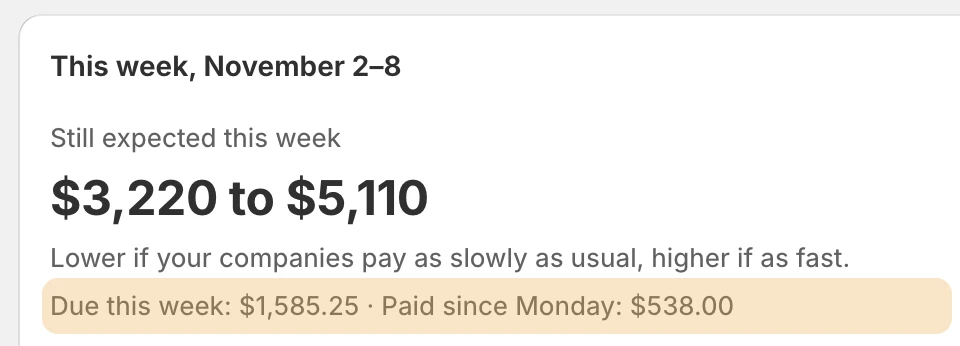
- Due this week is what is owed on orders whose due date by payment terms falls between this Monday and Sunday. It is not the top of the range: some of those orders will be paid early, some late, and some are not counted at all.
- Paid since Monday is the payments recorded since Monday on orders of the companies your plan covers, in your store’s currency, less any money that came back out, such as a chargeback.
Whose usual delay Quay uses
A line below the table says how the orders were moved. It ends with the How this is worked out link to this page.

- A company with payments on at least 5 orders is moved by its own usual delay. The line reads “Quay expects each company to pay as late as it usually does after the due date.”
- A company with payments on fewer than 5 orders is moved by your store’s average: the usual delay worked out from every company’s orders together. The line adds “For a company with fewer than 5 paid orders, it uses your store’s average.” If every company is in that position, it reads “None of your companies has 5 paid orders yet, so Quay uses your store’s average for each.”
- When your store has fewer than 5 such orders in all, Quay has no usual delay to go by and counts every order on its due date. The line reads “Your store has too little payment history yet, so these figures follow due dates.”
- Right after install, and when the check did not finish, the figures also follow due dates. The line reads “Quay hasn’t checked how your companies pay yet, so these figures follow due dates.” or “Quay couldn’t check how your companies pay this time, so these figures follow due dates until the next check.”
What is not counted
When some orders can’t be put in a week, they are listed under the table. Money from companies paying later than usual gets a note of its own, right under the table: “Not in this forecast: $745,385.13 of the $775,066.89 overdue. 134 companies owe it and already pay later than usual, so Quay can’t tell when it will come in.” When your debt is in more than one currency, the note leaves out the overdue total (“of the $775,066.89 overdue”). Every other amount is in one sentence after the method line, for example “Also not counted: $8,120.00 on orders not shipped yet, $1,200.00 on orders without payment terms, €4,000.00 in other currencies.” With no note above it, the sentence starts “Not counted:” and carries the later-than-usual amount too, as “from companies paying later than usual”. Each part appears only when it is more than zero.

- On orders not shipped yet: orders due on fulfillment that have not shipped have no due date to count from. They join the forecast once they ship.
- Later than usual: orders more overdue than the company’s late end, so Quay can’t say when they will be paid. The companies among them that have no policy and no hold are one row in Needs your decision, below the note, for example “94 of the 134 companies paying later than usual have no policy. They’re $580,246.65 overdue, and their new orders still go through.” Choose policies on that row opens the suggestions for exactly those companies.
- Already overdue: overdue orders while Quay has no usual delay to compare them with, because your store has too little payment history or the check has not finished.
- On orders without payment terms: with no due date there is no day to start from, so Quay leaves these out.
- In other currencies: the amount in each currency. With three or more currencies it reads “orders in 3 other currencies”.
Everything in this line is real money your companies owe. It is only missing from the range, so read the range together with this line.
When there is no forecast yet
- While Quay reads your past orders after install, the card says “Still reading your order history. The forecast appears when it’s done.” The Due this week and Paid since Monday line under it counts the orders read so far.
- If the reading stops short, it says “Quay couldn’t finish reading your order history. Contact support to restart it.”
- If Quay can’t read your store’s currency, it says “The forecast appears once Quay can read your store’s currency.”
- If no company owes anything, the card says so and still shows “Paid since Monday”.
The rest of the Dashboard is explained in Read the AR aging dashboard.
What happens next
The range, the four weeks and the Not counted line change as orders are placed, paid and shipped. How late each company usually pays is measured again when Quay reads your companies, which happens when you open the Dashboard an hour or more after the last read, or click Refresh.
Next: Add Quay's company card to Shopify admin
Why it matters, and how it works: Accounts receivable for Shopify wholesale: tracking AR aging and DSO
Still stuck? Use the chat inside Quay or write to hello@quayhq.com.